Cinematic worlds
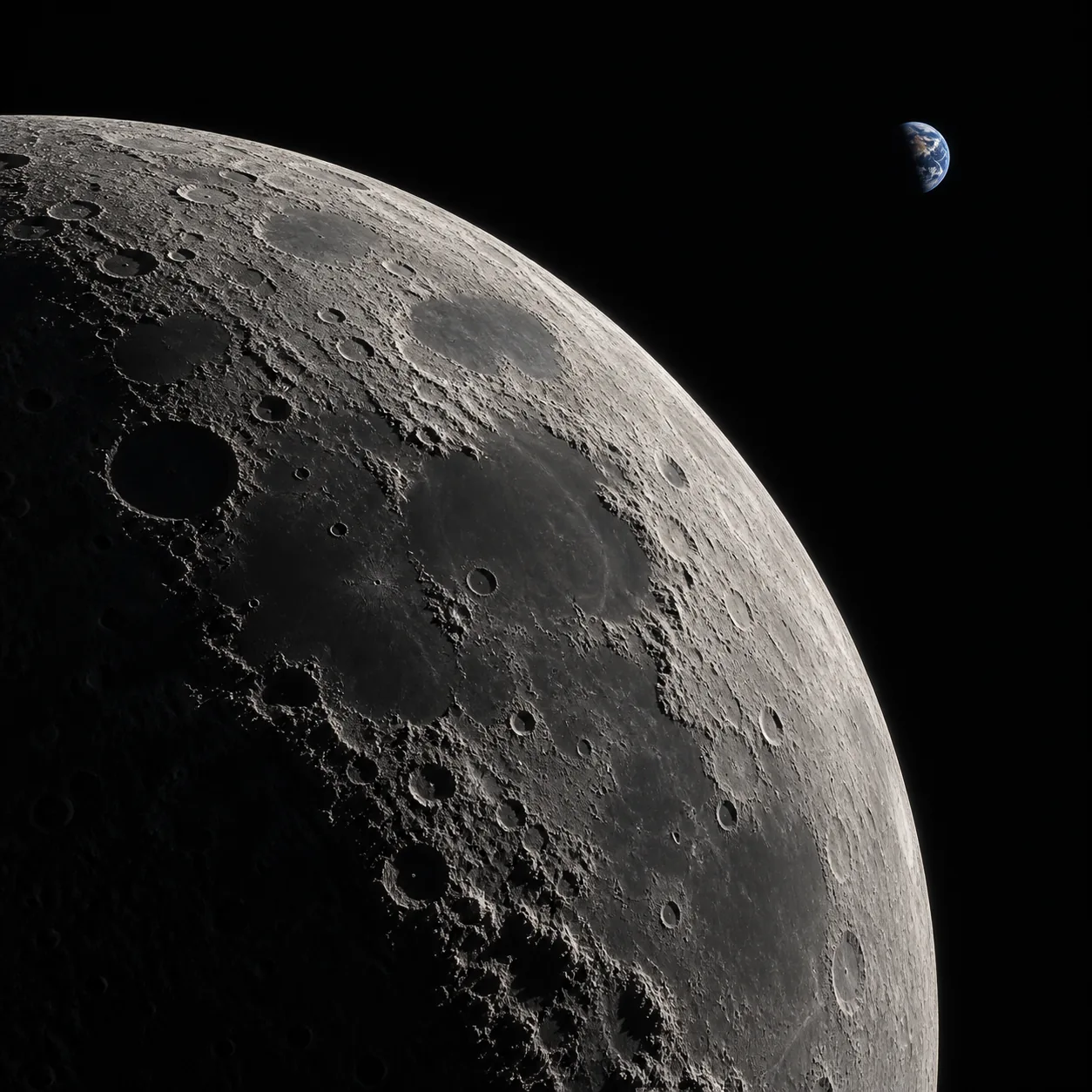
Explore a photographic Earth, a reimagined Sun, and richer planets and moons in the app’s interactive 3D renderer.
 Dust to Cosmos3.0
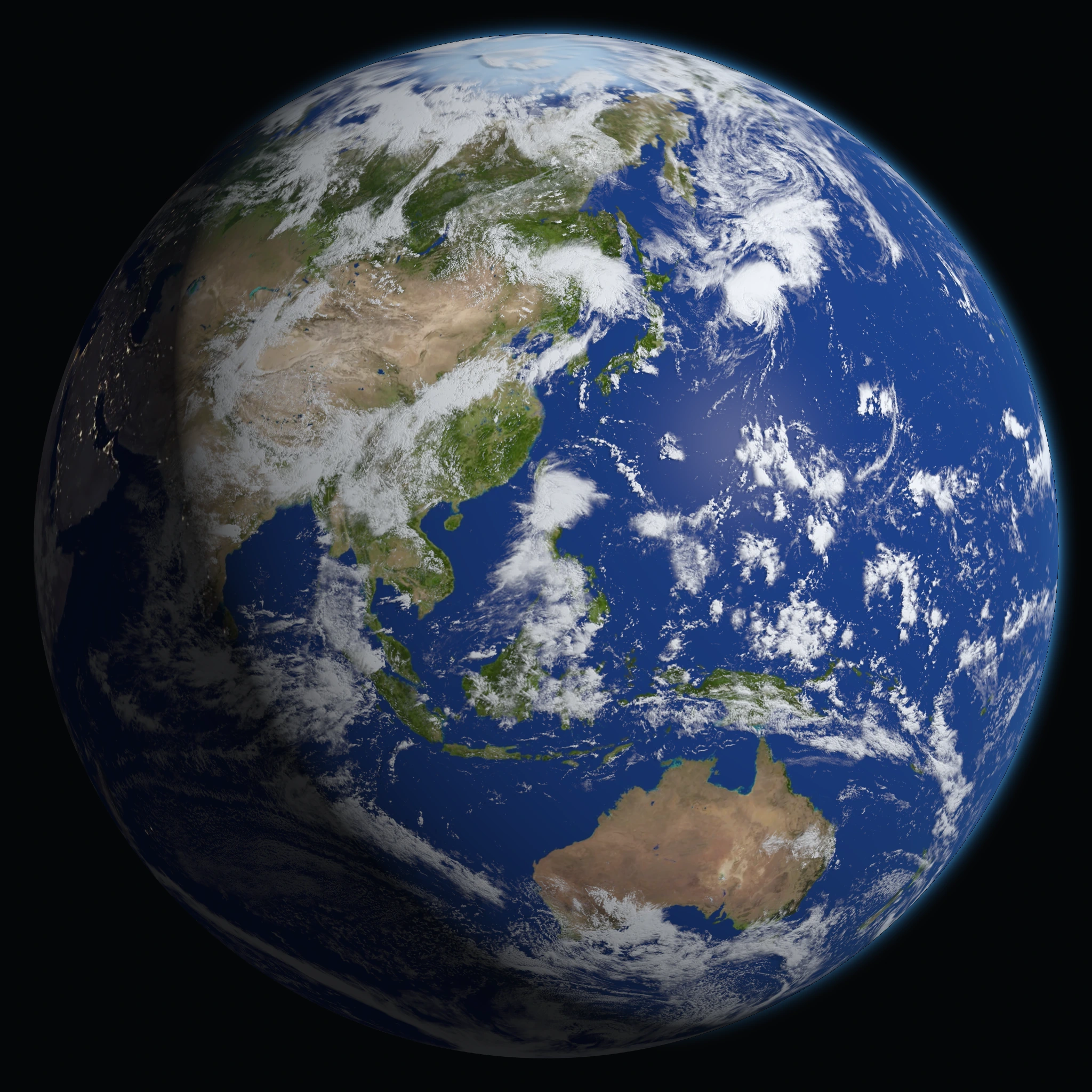
An extraordinary universe. Yours to explore.
Turn a sunlit Earth in your hands. Fly past Saturn’s rings. Follow Voyager beyond the planets. A deeper universe begins here.
Preview the upcoming update. Start exploring with the current app today.
New in 3.0
Sunlight over an ocean. Clouds casting shadows. A blue atmosphere fading into the dark. Meet a more cinematic Earth—and keep exploring beyond it.
Explore a photographic Earth, a reimagined Sun, and richer planets and moons in the app’s interactive 3D renderer.
See recent cloud observations and their capture times. Revisit available recorded frames, then continue into the Solar System at the same epoch.
Keep observations, reconstructions and modeled effects distinguishable. The Sun combines archival observations and visual models; it is not a live solar feed.
iPhone & iPad
A pocket universe on iPhone. An expansive observatory on iPad. Rotate a planet, explore a system, and give every discovery room to breathe.
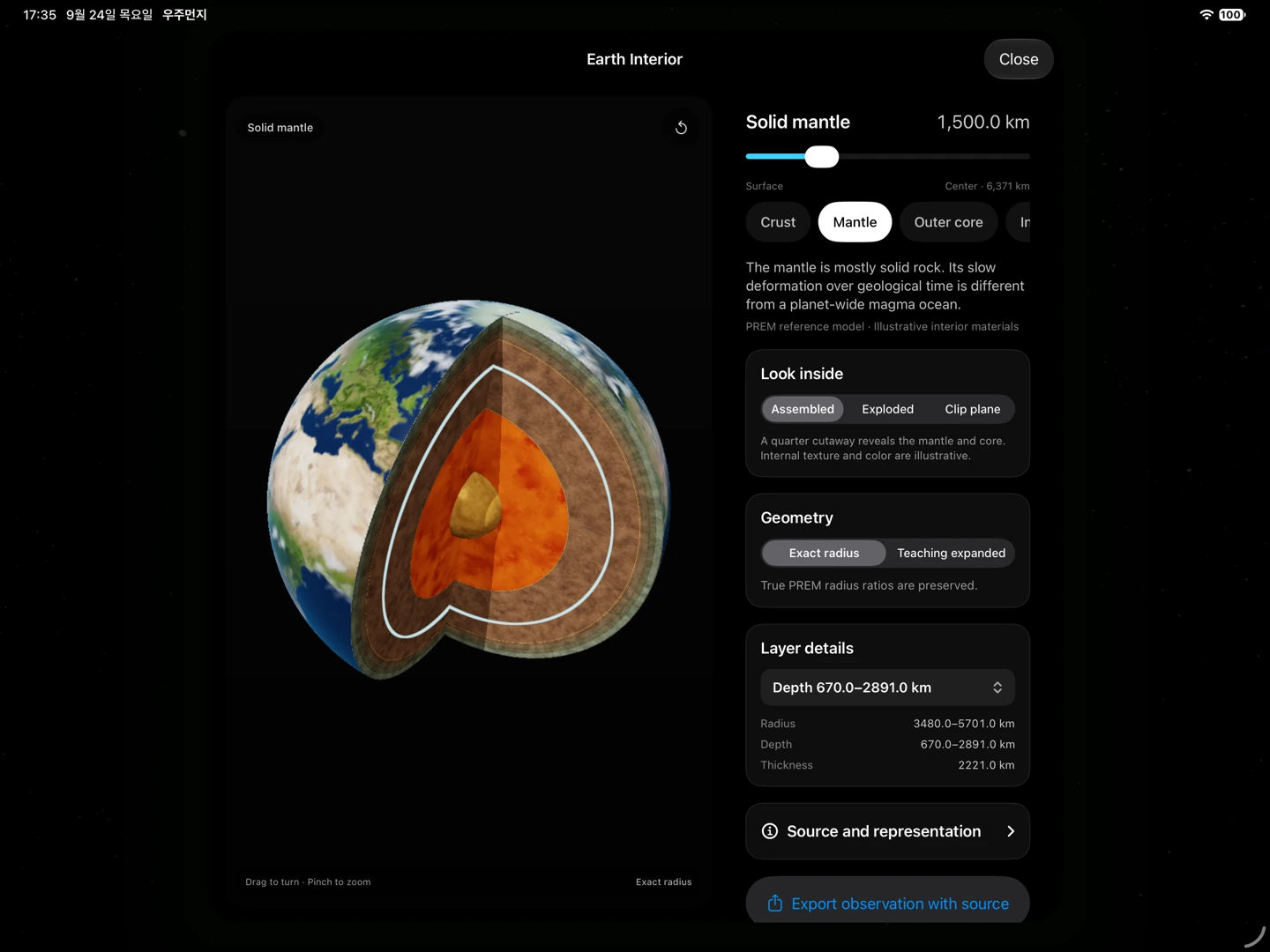
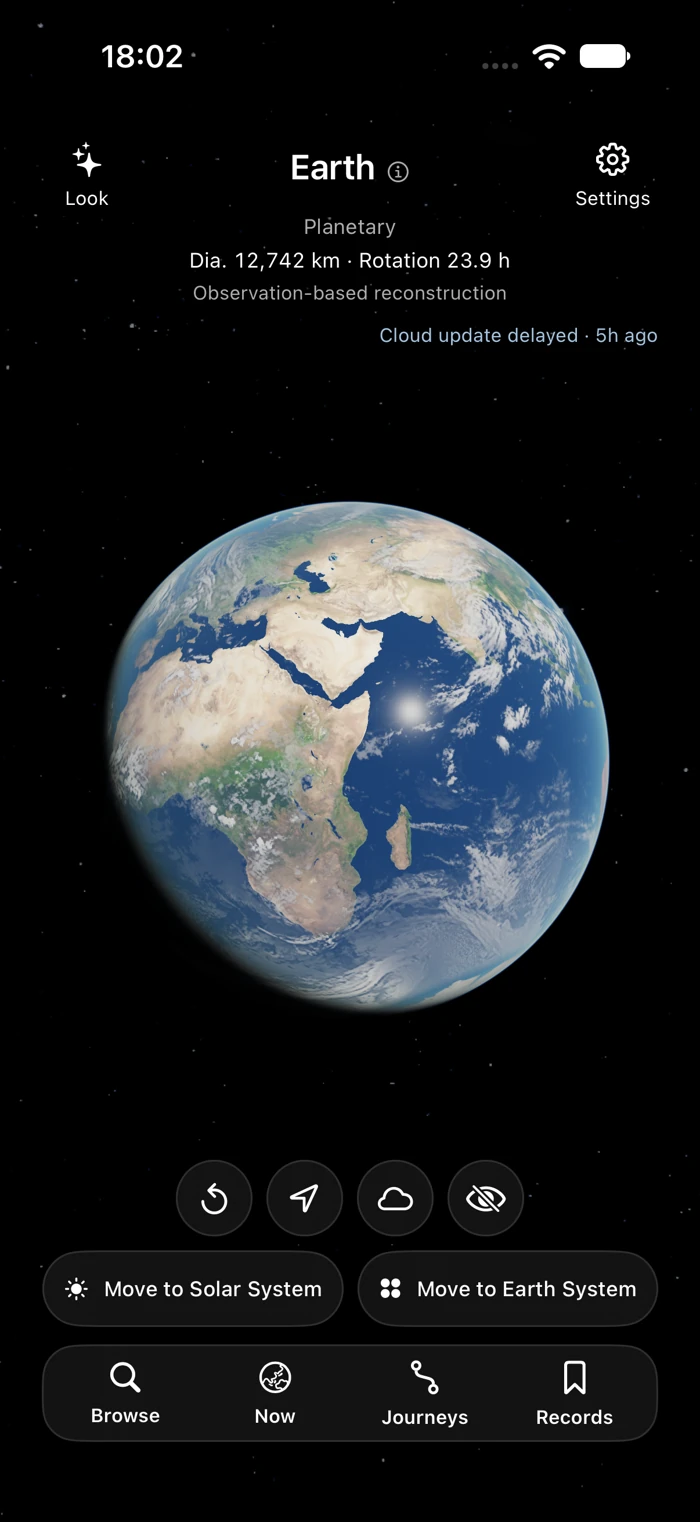
Landscape exploration gives planets, system navigation and requested detail panels their own space.
Browse, Now, Journey and Record. Explore the same universe in portrait on iPhone and landscape on iPad.
Turn worlds with a drag. Move closer with a pinch. Follow your curiosity through connected celestial systems.
The next chapter in 3.0
Take a spacecraft to the Moon and beyond. Steer with touch controls, accelerate through fictional obstacles, and collect points and exploration stamps.
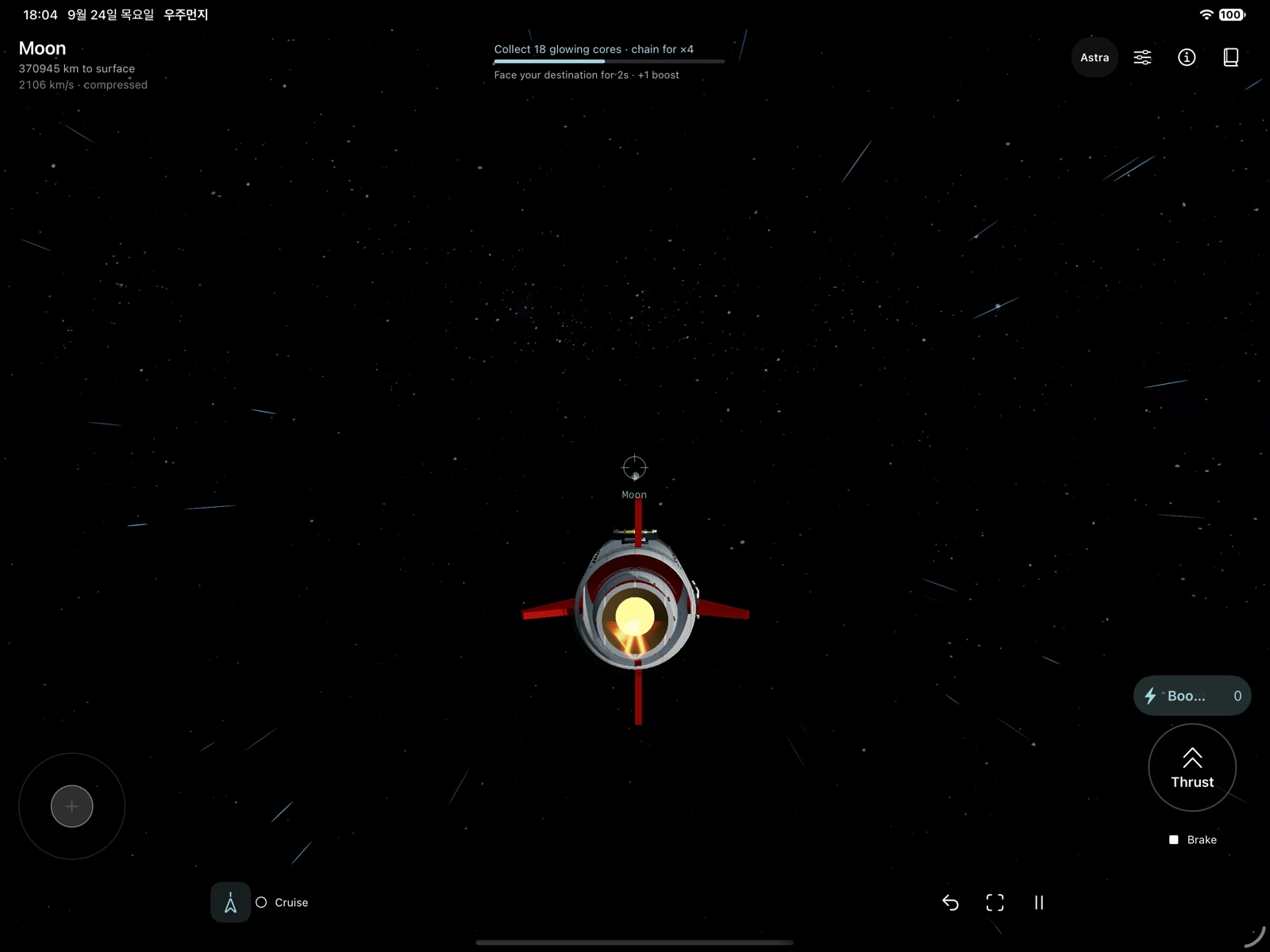
flight destinations
science dossiers
Earth epochs
Inspect both spacecraft, explore their sourced trajectories and discoveries, and revisit the 1989 Neptune encounter.
Move from modeled early environments to reconstructed continents and modern Earth. Explore 109 geography epochs spanning 540 million years.
Adjust the disc, light, color and motion while watching the renderer respond. Save a view that is distinctly yours.
Find your next discovery
Move through planets, moons, star systems, black holes and deep-sky objects. Select a world, focus on it, then keep its larger system in view.
Make today’s curiosity a place to begin. Explore Living Earth, inspect available cloud observations, or use a guided AR view to find a target in the sky.
Compare sizes and travel with light. Go further with piloted flight, Earth’s interior and Earth Through Time.
Save a scene, add a thought, and keep the source beside it. Your observations become a personal collection you can return to.
Dust to Cosmos Pro
3.0 brings the expanded experiences together in the same non-consumable Pro purchase. No new subscription. No separate ticket for each journey.
3.0 is in preparation. Availability and regional pricing will be shown in the app at release.
Core exploration, Voyager 1 and 2, the Neptune encounter, Moon finding, sources, basic sharing and 30/60 FPS stay free. Try Cinematic on Earth or the Sun for one minute.
Dust to Cosmos is a 3D space exploration app by SnapWorks Lab for iPhone and iPad. Explore connected worlds, compare their sizes, and read the evidence behind real discoveries. Source labels distinguish observations, reconstructions and modeled imagery.
Source organizations provide scientific data; they do not endorse this app. Cloud observations can be delayed or missing. Early Earth environments and internal materials include explanatory models.
Hero Earth textures: Solar System Scope / INOVE · CC BY 4.0. NASA-based maps, resized and converted, with illustrative lighting, atmosphere and accelerated rotation. Not current cloud observations or a native app capture.
Dust to Cosmos: Universe Scale is a 3D space exploration app for iPhone and iPad, made by SnapWorks Lab. Explore connected planets, moons, stars, black holes and deep-sky objects, compare their sizes, and discover cosmic time with visible scientific sources.
3.0 is being prepared for release. App Store links open the currently published version. Screens on this page were captured from the 3.0 development build; check the store for update availability.
Yes. iPhone defaults to portrait and also supports landscape. iPad uses a broad landscape workspace for exploration and detail.
Core exploration, Voyager 1 and 2, the Neptune encounter, Moon finding, sources, basic sharing and 30/60 FPS stay free. Try Cinematic on Earth or the Sun for one minute. Advanced experiences share one non-consumable Pro purchase, with no subscription. High-refresh Pro Motion requires Pro; actual frame rates depend on the scene, hardware, temperature and power state. Check the app for regional pricing.
It depends on the feature. Cloud observations show capture times and can have gaps. The cinematic Sun uses archival data and modeled effects. Voyager uses public trajectory coverage, while piloted flight is virtual. Deep-time geography is reconstructed; early environments are modeled. Source and Truth Class information distinguish these cases.
Bundled celestial content and offline science materials can be explored without a continuous connection. Fresh cloud observations and other network data need internet access. Cloud replay depends on the validated records actually available on the device.
Yes. In July 2026, Dust to Cosmos appeared in “Best New Apps and Updates” in the United States and “Hot This Week” in Canada, on both iPhone and iPad. These placements were documented on July 4, 2026; that is the verification date, not a confirmed first day of featuring. Apple’s collections change over time. This recognition of the app is separate from the upcoming 3.0 release.
3.0 · Coming soon
Start exploring today. A whole new depth arrives with 3.0.
View on the App StoreDownload the current version · iPhone & iPad